Wednesday, March 23, 2016

No. 19 Delusion

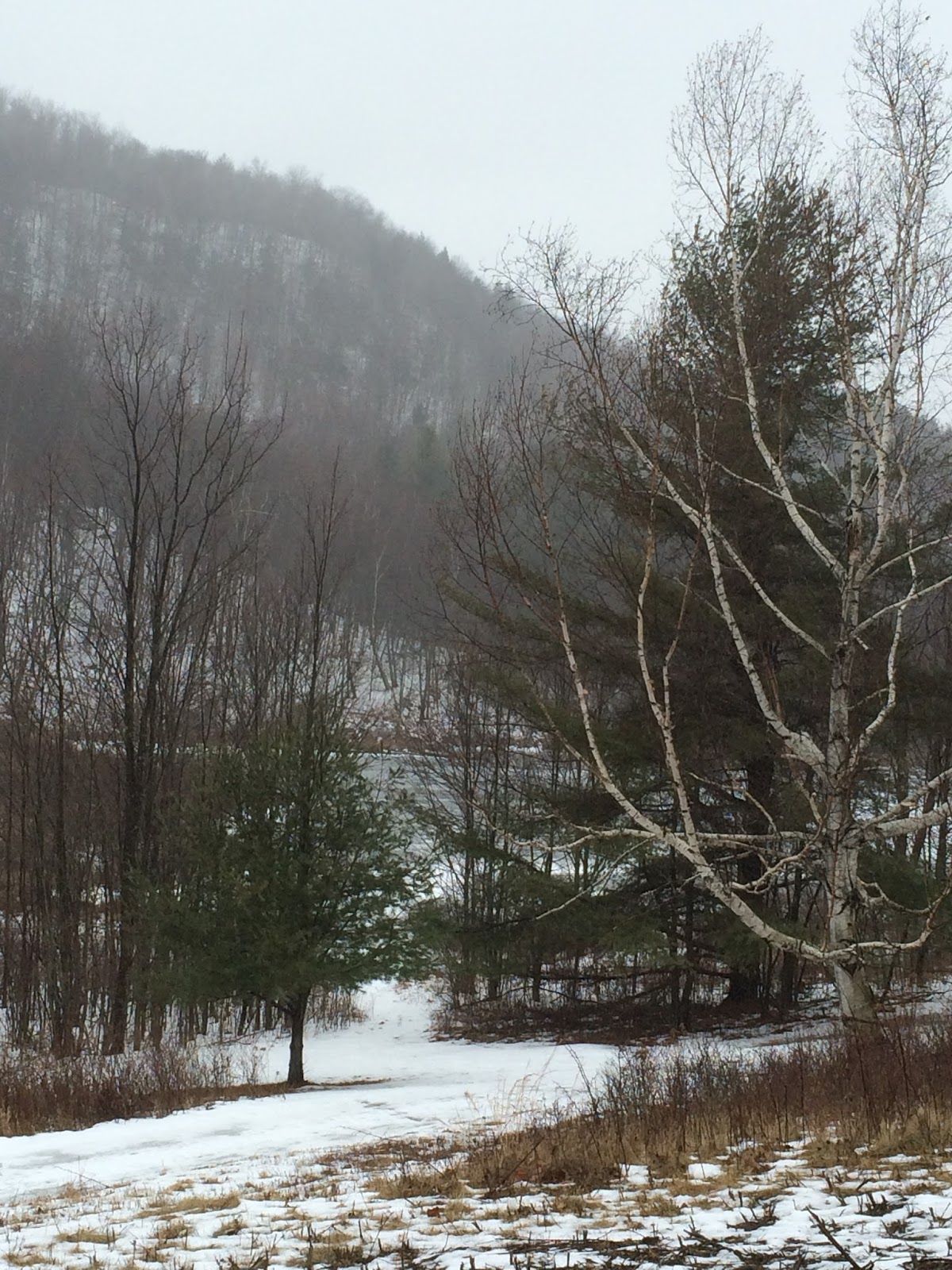
This one is a waltz. Schubert never provides many musical markings and in this song there are even fewer indications than usual. Perhaps the Austrian composer assumed that everyone would know how to play a waltz. I don't yet know how this song wants to be sung. We experiment every time, sometimes lifting over the bar lines, sometimes leaning forward, searching for that lilting, pressing motion. The picture below is my vision of a "helles, warmes Haus."

No. 19 Delusion
Ahead a friendly dancing light
I follow, trailing left and right
I gladly go and know full well
It has this wanderer in its spell
Ah! Only one so pained it seems
Gives gladly to brightly beckoning gleams
Behind the ice and night and doom
There lies a bright inviting room
Within a loving soul resides
Delusion is the only prize


19. Täuschung

Ein Licht tanzt freundlich vor mir her,
Ich folg' ihm nach die Kreuz und Quer;
Ich folg' ihm gern und seh's ihm an,
Daß es verlockt den Wandersmann.
Ach ! wer wie ich so elend ist,
Gibt gern sich hin der bunten List,
Die hinter Eis und Nacht und Graus,
Ihm weist ein helles, warmes Haus.
Und eine liebe Seele drin. -
Nur Täuschung ist für mich Gewinn !

Tuesday, March 22, 2016

No. 18 Stormy Morning

Our last concert approaches:
April 2 at 8:00 PM
New York Theatre Ballet Studio
131 East 10th Street, 2nd Floor
New York, NY 10003
All tickets $10

18 Stormy Morning
The storm has torn to pieces
The heavens' grey array
The tattered storm clouds flutter
Within their muted fray
And fiery embers glowing
Emerging from the gloom
Now this I call a morning
It fits my state of doom
My heart looks to the cloud shapes
To see its image there
It's nothing but the winter
The winter cold and bare

18. Der stürmische Morgen
Wie hat der Sturm zerrissen
Des Himmels graues Kleid !
Die Wolkenfetzen flattern
Umher im matten Streit.
Und rote Feuerflammen
Zieh'n zwischen ihnen hin;
Das nenn' ich einen Morgen
So recht nach meinem Sinn !
Mein Herz sieht an dem Himmel
Gemalt sein eig'nes Bild -
Es ist nichts als der Winter,
Der Winter kalt und wild !

No. 17 In the Village

Some have said this poem is a commentary on bourgeois life, that it is about people in a provincial town consoling themselves nightly with the sugarplums of their merchant class aspirations. Personally, I never envisioned this village as anything but poor. I'm sure that I'm wrong in this, but I can't shake the image. All translations are subjective and in this one my vision of the town is betrayed by words like "scraps" and "portion," connoting lack. Reading through the many books on Schubert, I see this kind of subjectivity in the different authors' versions of the man.
Schubert's economic status is curiously vague in the literature I've read. He comes across as romantically penniless or magically salient at different times and there is a lot of room to read between the lines. My version of Schubert is somewhere in between.
I'm not sure what the modern day equivalent of his class would be, but I'll be wildly subjective here and call him a 'baby blue collar' teacher. By that I mean he was on the lower cusp of the middle class, not the upper one. Although he was one of the first freelance composers to make a living from his art without the benefits of a court or church position, he often had to return to teaching high school when times got tough. His father ran a gymnasium, a sort of 19th Century preparatory school, and Schubert taught there for most of his life.
My Schubert isn't ecstatic about teaching to pay the bills, but he is aware that this arrangement affords him a level of artistic independence not enjoyed by court musicians. My version of the man is sometimes broke, sometimes flush, but never beholden.
Of all the songs, I found this one the hardest to translate because of the double meanings of almost every word. I tried to find English equivalents for Müller's unstressed final syllables like "Hun-de" and "Bett-en" but finally settled on single-syllable words like "hounds" and "beds." This affects the musical line and note values. To maintain the rhyme scheme and atmosphere in the last lines I had to accentuate the idea that the poet is beyond the renewing power of sleep, a not-so-subtle repetition of theme that doesn't exist in the German.
Our last concert is coming up:
April 2 at 8:00 PM
New York Theatre Ballet Studio
131 East 10th Street, 2nd Floor
New York, NY 10003
All tickets $10
17. In the Village
The barking of hounds, the rattling of chains
The townsfolk asleep in their beds again
Dreaming of riches they'll never have
Turning their thoughts to the good and the bad
When morning comes and all is unfrozen
Well then, their portions have been chosen
They're hopeful the scraps they have forgotten
They'll find awaiting in pillow cotton
Drive me away you hounds from sight
Let me not rest in the hour of night
I've reached the end of dreams' undoing
Why should I bother with sleep's renewing?
17. Im Dorfe
Es bellen die Hunde, es rasseln die Ketten;
Es schlafen die Menschen in ihren Betten,
Träumen sich manches, was sie nicht haben,
Tun sich im Guten und Argen erlaben;
Und morgen früh ist alles zerflossen.
Je nun, sie haben ihr Teil genossen
Und hoffen, was sie noch übrig ließen,
Doch wieder zu finden auf ihren Kissen.
Bellt mich nur fort, ihr wachen Hunde,
Laßt mich nicht ruh'n in der Schlummerstunde !
Ich bin zu Ende mit allen Träumen.
Was will ich unter den Schläfern säumen ?


Thursday, March 17, 2016

Next concert: March 18 at 8:00 in Clinton Hill, Brooklyn

Friday March 18 @ 8:00 PM
Fireside Series, Brooklyn Studios for Dance
210 Lafayette Avenue, Brooklyn NY 11238
https://www.facebook.com/events/228332607511716/ 

Franz Schubert's famous song cycle, Winterreise (The Winter Journey) is a seventy-minute meditation on love and loss in wintertime. Its twenty-four songs form a story arc that has captivated audiences since 1828. Darren Chase sings his own English translation of the work, creating a direct connection between listener and text. Michael Scales accompanies this two-man opera.

Erik Satie's Pièces froides (Cold Rooms) were composed in Paris the winter of 1896-7, offering both humor and introspection as remedies for the season's numbness and deprivation. These two sets of solo piano works form a prelude to Winterreise.

A warm fire and hot meal will help stave off the cold; BYOB for further warmth. 


I close again my eyelids
My heart still warmly strains
Will green leaves grow in the window?
Will I hold my darling again?
-- Winterreise Song 11, "Dream of Spring"

For more information:

darrenchase.net


Thursday, March 10, 2016

No. 16 Last Hope


After our last performance someone asked "What changes do you make after you perform your translations?" I answered that I make very few because the possibilities are so limited. But now I'm rethinking that.
Watching the video of the last concert I notice that sometimes old versions of certain lines crept back in and, at other times, I made 'mistakes' that were more like real-time edits.
I changed this translation a lot after our first runthrough, subordinating words to ideas. In the lines, "But the wind plays with my leaf/I shake too, little I can" I disregard syllable stress completely in order to preserve this important image.

No. 16 Last Hope
Here and there throughout the forest
Many colored leaves remain
And I stand before the branches
Deep within my thoughts again
Gazing at one single leaf
There I hang my hopeful plans
But the wind plays with my leaf
I shake, too, little I can
Ah, the leaves fall from the branches
So my hopes fall none to save
I am falling to the cold ground
Weeping beside my hopes' grave

16. Letzte Hoffnung
Hie und da ist an den Bäumen
Manches bunte Blatt zu seh'n,
Und ich bleibe vor den Bäumen
Oftmals in Gedanken steh'n.
Schaue nach dem einen Blatte,
Hänge meine Hoffnung dran;
Spielt der Wind mit meinem Blatte,
Zittr' ich, was ich zittern kann.
Ach, und fällt das Blatt zu Boden,
Fällt mit ihm die Hoffnung ab;
Fall' ich selber mit zu Boden,
Wein' auf meiner Hoffnung Grab.


No. 15 Crow

No. 15 Crow

High above me flies a crow
Ever since the city
Always now and every hour
Round my head it's with me
Crow, wondrous curious thing
Will you ever leave me?
Do you mean to make of me
Carrion for your feasting?
Well, you needn't keep to long
With this walking staff's stride
Creature let me finally see
Constancy to graveside

15. Die Krähe
Eine Krähe war mit mir
Aus der Stadt gezogen,
Ist bis heute für und für
Um mein Haupt geflogen.
Krähe, wunderliches Tier,
Willst mich nicht verlassen ?
Meinst wohl, bald als Beute hier
Meinen Leib zu fassen ?
Nun, es wird nicht weit mehr geh'n
An dem Wanderstabe.
Krähe, laß mich endlich seh'n
Treue bis zum Grabe !

Monday, March 7, 2016

No. 14 The Grey Haired Man

Yesterday we performed the entire cycle for the first time. Poems like this one made me worry about finishing the translations on time.
This song is so diaphanous that I couldn't alter any syllable very much from the German without disturbing the entire musical setting. Generally this is more the case with the second half of cycle. The later songs demand more literal translations but offer fewer possibilities within their increasingly sparse language.
I attempted many pretty translations that read well as blog posts but fell flat when I sang them. It was impossible to keep Schubert's musical gestures in the line "mir übers Haar gestreuet" with anything more beautiful than the very clunky "All through my hair it sifted."

No. 14 The Grey Haired Man
The frost had left a whitened sheen
All through my hair it sifted
I thought I was a grey old man
At once my spirits lifted
But soon the melting snow revealed
Again this youthful knave
My youth no longer was concealed
How far away the grave!
From evening till the morning light
How many heads are greying
How strange that my hair never turned
Through all my lonely straying

14. Der greise Kopf                         
Der Reif hatt' einen weißen Schein
Mir übers Haar gestreuet;
Da glaubt' ich schon ein Greis zu sein
Und hab' mich sehr gefreuet.
Doch bald ist er hinweggetaut,
Hab' wieder schwarze Haare,
Daß mir's vor meiner Jugend graut -
Wie weit noch bis zur Bahre !
Vom Abendrot zum Morgenlicht
Ward mancher Kopf zum Greise.
Wer glaubt's ? und meiner ward es nicht
Auf dieser ganzen Reise !